
Our latest report tracks the spread of gentrification across the inner-cities of Toronto, Montreal, Vancouver, Calgary, Ottawa, Edmonton, Winnipeg, Quebec City, Hamilton, Halifax, and Victoria. In every city, we document an alarming rise in the number of gentrifying neighbourhoods, and in the number that have fully gentrified.
City by city, the report maps out where gentrification began and where it has deepened and spread. Each map highlights the places where working class and racialized communities have faced the greatest displacement pressures in recent decades. They also shine a spotlight on the neighbourhoods where lower-income households are currently most at risk of being displaced. It is in these areas that the need for affordable housing and strong tenant protections is greatest.
How do we track gentrification?
Mapping the Gentrification of Canadian Cities 1961-2021 was authored for New Housing Alternatives by Alan Walks, a professor of urban planning and geography at the University of Toronto, and Sean Grisdale, a Postdoctoral Fellow at the School of Urban Planning at McGill University). It updates and expands on the research of Walks and Maaranen (2008) who used census data to map gentrification in Canada’s three largest metropolitan areas (Toronto, Montreal and Vancouver) between 1961 and 2001.
To identify gentrifying neighbourhoods, we track changes in the three variables proposed originally by Ruth Glass as characterizing gentrification: rising income and social status, rents and housing values, and changes housing tenure from renters to owner-occupiers (Glass, 1964). Only neighbourhoods that began the study period with below-average rents, incomes and social status, and proportions of home-owners, are potential candidates for gentrification. Of these, if both the neighbourhood averages of individual income and household income rise above the metropolitan averages, they are seen to have completed the gentrification process. Other neighbourhoods that experience rising rents and land values, incomes and social status, and increasing proportions of home-owners, but which did not see their average incomes (both individual and household) rise above the metropolitan average, are considered to be still gentrifying (and the process therefore incomplete).
Key findings
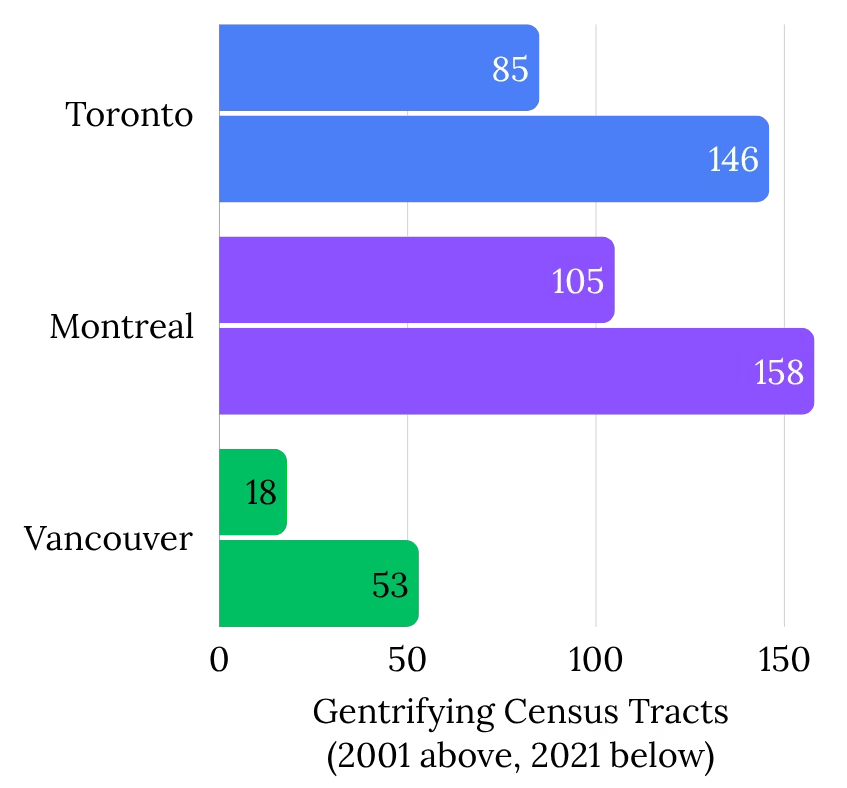
(1) From 2001 to 2021, the number of neighbourhoods that are gentrifying has expanded dramatically. The number of gentrifying census tracts rose in every metro area studied, including in: Toronto (85 to 146); Montreal (105 to 158), and; Vancouver (18 to 53). In Canada’s mid-sized cities, gentrification is shown to be a more recent but growing phenomenon, increasingly pricing out lower-income households.
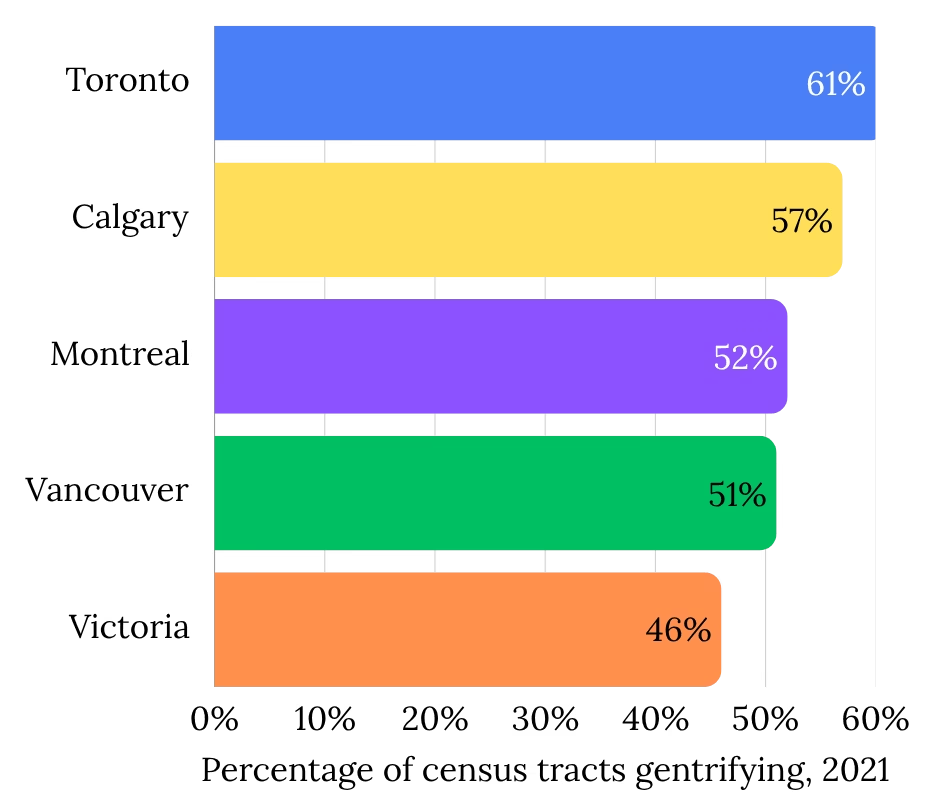
(2) Gentrification has now spread across the majority of the inner-city of all three of Canada’s largest metro areas. The five cities where gentrification has spread farthest are: Toronto, where 61% of the inner-city census tracts are gentrifying; Calgary (57%); Montreal (52%); Vancouver (51%); Victoria (46%).
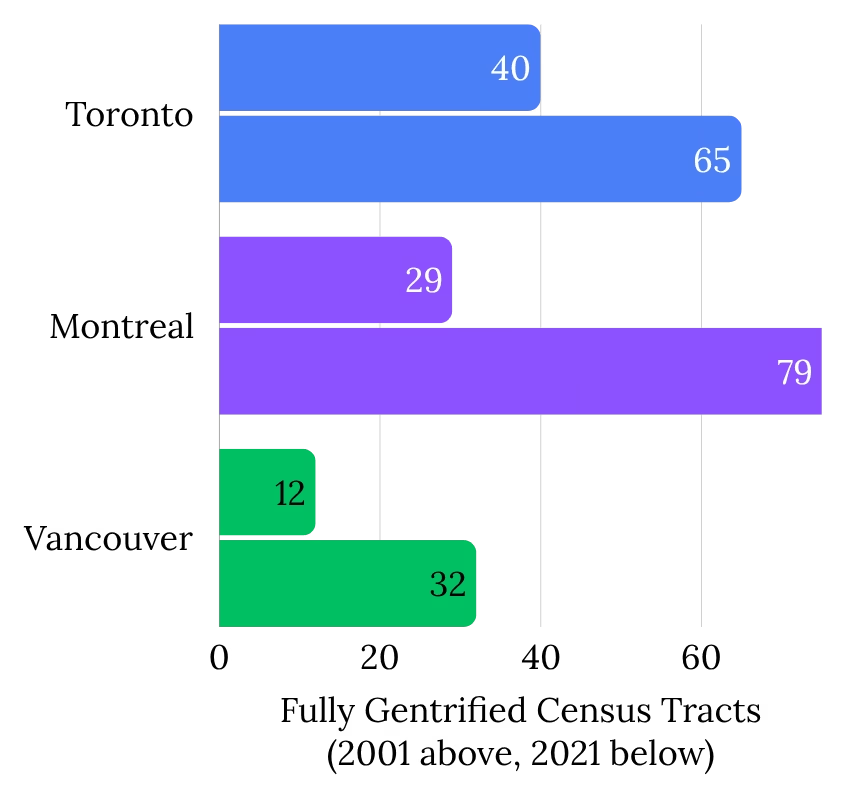
(3) From 2001 to 2021, the number of neighbourhoods that have fully gentrified has grown substantially, including in: Toronto (40 to 65); Montreal (29 to 79); and Vancouver (12 to 32).
Analysis
The report documents a long running tendency for gentrification to spread across Canada’s inner-cities, pushing up housing and land values and creating exclusive high-income neigbourhoods. This is a problem, given that the process tends to involve an erosion of the affordability of rental housing and a de-conversion of some housing units from rental to ownership tenure. As the stock of rental housing affordable to lower-income households diminishes, lower-income residents tend to be displaced, reducing their access to local community connections, jobs, and public services.
Gentrification is now the main form of neighbourhood change occurring within the pre-World War II inner-cities of Canada’s four largest cities (Toronto, Montreal, Vancouver and Calgary). Toronto has the highest proportion of inner-city neighbourhoods that are gentrifying (61%). It also shows the second-highest proportion (27 percent) of gentrifying tracts that completed the gentrification process over the study period. Calgary shows the second-highest proportion of pre-war inner-city tracts experiencing some form of gentrification, at 57 percent. However, the proportion that fully gentrified (17.5 percent) is lower than the three-largest cities, in part because gentrification began more recently in most neighbourhoods. Montreal’s inner-city has the third-highest proportion, with a full 52 percent of the inner-city experiencing gentrification, and 26 percent fully gentrified. It is followed closed by Vancouver, where gentrification has spread over 51 percent of the inner-city. Vancouver also has the highest proportion that have fully gentrified (31%). However, note that because so much of Vancouver’s inner-city was populated by middle-class or elite neighbourhoods early on, the proportion of neighbourhoods that could be candidates for gentrification is lower than in Toronto and Montreal.
Canada’s seven mid-sized cities all reveal a more recent experience with gentrification. A notably smaller proportion of their inner-city neighbourhoods have fully gentrified. These cities may offer lessons for slowing gentrification and preventing the displacement of lower-income households. However, the report’s findings raise concerns that this inequitable and traumatic pattern of neighborhood change will continue to spread here, and across Canada’s larger cities, unless new approaches to developing and providing housing are fostered.
Conclusion
Thirty years ago, David Ley (1996) warned that, absent substantial changes to our housing system, we should expect the march of gentrification to continue advancing across Canada’s central cities.
Today, gentrification has advanced across many, and in some cases most of the older neighbourhoods of Canada’s major cities. In the absence of substantial government interventions, such as — stronger rent controls, stronger protections against evictions, and large-scale investments in building and acquiring non-market housing — we expect the spread to continue.
References
Glass, R. (1964) “Introduction: Aspects of Change,” in Macgibbon and Kee. (Eds.) Aspects of Change, London: Centre for Urban Studies. xiii.
Ley, D. (1996) The New Middle Class and the Re-Making of the Central City. Oxford: Oxford University Press
Walks, A. and Maaranen, R. (2008) “The Timing, Patterning and Forms of Gentrification and Neighbourhood Upgrading in Montreal, Toronto, and Vancouver 1961 to 2001.” Toronto: University of Toronto Cities Centre, Research Paper 211