
Across Canada, supportive housing providers face a patchwork of overlapping and inconsistent regulatory frameworks.
NHA’s new report, Defining Supportive Housing in British Columbia and Ontario: Policy Implications and Considerations, explores the challenges this poses to those working to end homelessness. It proposes clear solutions that could help advance a more effective supportive housing system
The term supportive housing has become a broad descriptor for a wide range of housing models offering varying levels of services and support. In Canada, the absence of a shared definition has produced a fragmented landscape marked by inconsistent policies, uneven service delivery, siloed funding, and unclear regulatory oversight. For people whose needs cannot be met by other housing models, supportive housing is often essential, frequently accessed only after multiple unsuccessful housing placements and prolonged homelessness.
Canada’s homelessness crisis is driven by a chronic shortage of affordable housing and a severe deficit in supportive housing supply. These structural pressures are intensified by definitional ambiguity, which complicates system planning, funding, and accountability. While governments increasingly acknowledge that homelessness cannot be resolved without supportive housing, policy clarity remains limited.
Our new report, written by Dr. Alina McKay and Ella Barrett, compares the range of supportive housing definitions used to guide programs in Ontario, British Columbia and at the federal level. Assessing their strengths and limitations, it concludes by recommending core characteristics that could provide the basis for a consistent and effective approach to delivering supportive housing.
Comparing Supportive Housing Frameworks: Policy Without Precision
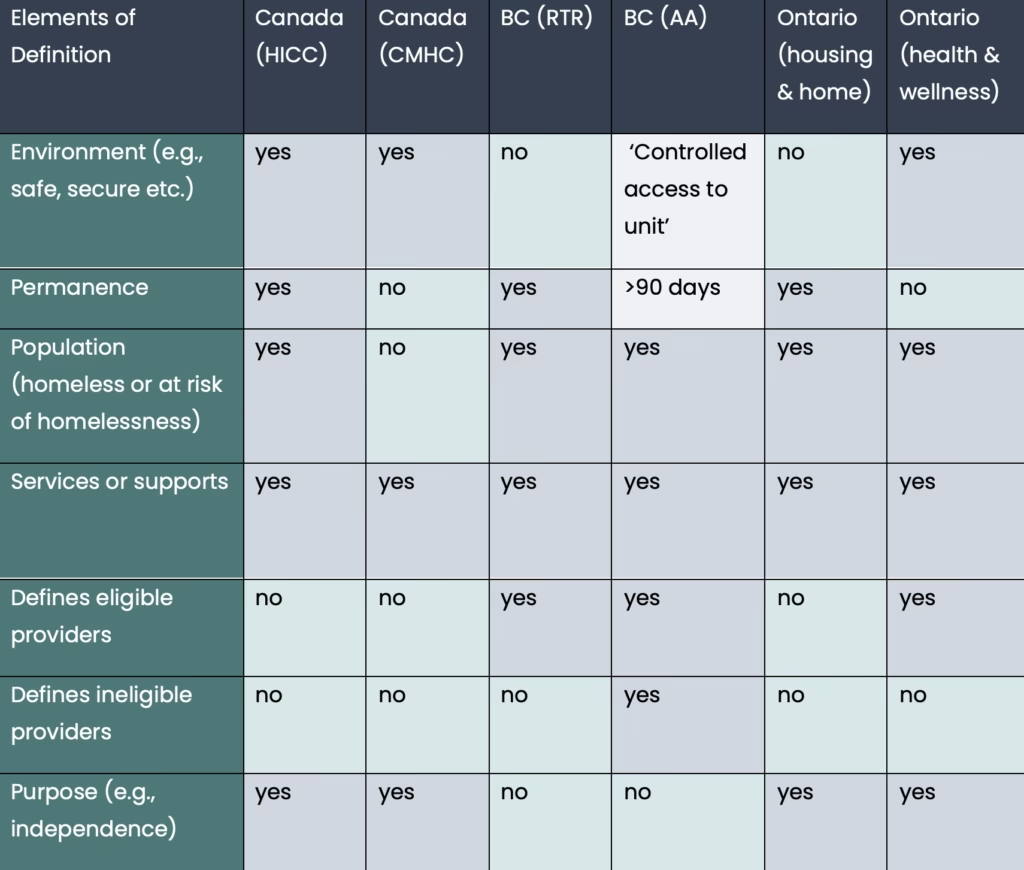
At the federal level, supportive housing is defined through policy rather than legislation, and definitions vary across programs. Two federal entities are central: Housing, Infrastructure and Communities Canada (HICC), which administers Reaching Home, and the Canada Mortgage and Housing Corporation (CMHC), which supports housing through the National Housing Strategy.
Reaching Home defines supportive housing as permanent housing with no time limits, paired with rental assistance and individualized supports for people with higher needs related to physical or mental health, developmental disabilities, or substance use. It explicitly targets individuals who are homeless or at risk of homelessness and emphasizes ongoing support, including coordination with clinical services and assistance to maintain housing stability.
CMHC’s definition focuses primarily on the housing environment, describing supportive housing as safe, secure, home-like accommodation with services such as meals, housekeeping, and social activities designed to promote independence and dignity. Unlike Reaching Home, CMHC does not specify permanence, target population, or the inclusion of clinical or therapeutic supports.
These divergent definitions reflect the absence of a coherent federal framework. Differences in emphasis — permanence, eligibility, and service scope — create inconsistencies that cascade through provincial and local systems.
British Columbia is the only province with legislated definitions of supportive housing, set out in the Residential Tenancy Regulation (RTR) and the Assessment Act. Under the RTR, a unit qualifies as supportive housing if it: is operated by a supportive housing provider; houses tenants assessed as homeless or at risk; provides access to housing stability supports, and; is offered on a permanent basis, as opposed to being time-limited. This explicit emphasis on permanence draws a useful distinction between supportive housing and transitional housing, such as homeless stabilization beds or housing for women and gender-diverse people fleeing violence. The regulation further requires that supports be voluntary, delivered on-site by support workers, and funded by operators or government. Eligible supports include activities promoting community inclusion, independent living skills, collaborative planning, and access to community resources.
BC’s Assessment Act definition reinforces these elements, describing supportive housing as long-term housing with on-site supports for people previously homeless or at risk who face barriers such as mental illness or addiction. It explicitly excludes licensed care facilities and group homes requiring continual daily assistance. Together, these definitions provide rare legal clarity regarding population, permanence, and service scope.
Ontario, by contrast, lacks a legislated definition. The term supportive housing is used inconsistently, often referring to housing for a wide range of people, including seniors or people with disabilities. Different definitions appear in government housing policy and health policy, reflecting divided responsibility. One definition assigns responsibility for rental supports to the Ministry of Housing and 24-hour personal supports to the Ministry of Health. Another definition frames supportive housing as long-term housing with flexible supports to promote independence and prevent homelessness.
Concerningly, certain types of housing defined as supportive in Ontario (i.e., temporary accommodations associated with rehabilitative or life-skills programs intended to last no more than four years) are excluded from the province’s Residential Tenancy Act. The absence of a clear definition of “temporary” allows some transitional programs to operate indefinitely, blurring distinctions between transitional and permanent housing and leaves tenants with poor protections against eviction.
An overview of each definition is provided in Table 1 below.
Challenges to the Delivery of Supportive Housing
Federal withdrawal from affordable housing investment in the early 1990s created structural shortages that continue to constrain access to supportive housing and limit pathways out. With limited affordable rental options, tenants who no longer require intensive supports often have nowhere to move, while those who need supportive housing face long waitlists and prolonged homelessness.
A core systemic gap is the failure to legislate clear distinctions between permanent and transitional housing. The absence of precise legal definitions allows transitional models to function without time limits or exit pathways. This creates system bottlenecks: transitional units become de facto permanent, while individuals with acute needs remain unhoused.
Regulatory ambiguity can also lead to weaker tenant protections and less effective provider operations. In the absence of a consistent regulatory framework, providers must navigate overlapping housing, health, and social service frameworks without clear guidance. This results in inconsistent application of tenancy protections and operational obligations. This is especially pressing in Ontario, where housing that includes therapeutic or support components may fall into unclear regulatory categories. It also results in siloed funding streams that do not reflect the full cost of delivering permanent housing with long-term supports. Operators are expected to provide housing stability and intensive services without integrated, sustainable funding.
Policy Implications: The need for a dependable supportive housing framework
This report reveals a fragmented and inconsistent policy landscape, which undermines efforts to plan, fund, and safeguard housing for those at risk of homelessness. There is an urgent need for broad-based collaboration to develop a consistent framework for effective service delivery. This will require agreement on the defining characteristics of effective supportive housing. Our comparative assessment provides useful insights to contribute to this timely discussion, identifying four defining characteristics:
- Tenancies are Secure and not Time-limited
Effective supportive housing is permanent housing, not transitional housing. Its residents are provided security of tenure that is not time-limited and standard legal protections, such as protections against eviction. - Serves People Experiencing or at Risk of Homelessness
Effective supportive housing primarily serves low-income individuals and households who are homeless or at risk. - Services and Supports are Provided on a Voluntary Basis
Effective supportive housing provides access to supports on a voluntary basis. Access to housing should not be conditional on service participation. - Operated by Non-Profit or Government Providers
Because supportive housing relies on public funding, it should be delivered by non-profit or government entities that are mission-driven and accountable for public resources.
These four defining characteristics provide a firm basis on which to build a more coherent, equitable, and effective supportive housing system. Doing so is crucial if governments are to reverse the trajectory of Canada’s deepening homelessness crisis and realize the right to housing for all.