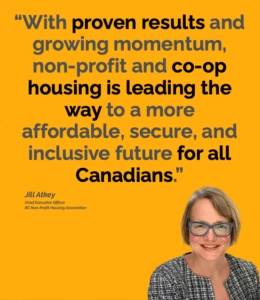
This week, we’re excited to share the 2nd episode of the New Housing Alternatives podcast, in which hosts Cherise Berda and Ren Thomas are joined by Jill Atkey, CEO of the BC NonProfit Housing Association (BCNPHA).
We talk about the impressive growth of the movement for community-owned housing in British Columbia — the result of decades of organizing between non-profit, co-op & indigenous-led housing organizations. These alternative housing models represent a fast-growing sharing of homes built in recent years in BC. Today, they own over 1/4 of all rental homes and counting.
The conversation unpacks the history, challenges, and opportunities facing the sector, with a special focus on BC’s unique approach.
We ask Jill about recent wins in the movement, like the BC Rental Protection Fund (which helps non-profits acquire private apartments to protect tenants).
We also discuss the evolving role of the Federal government in supporting non-profit housing growth, and the potential of the new Federal program, Build Canada Homes.
Finally, we ask why these community-led models may be preferable to government ownership.
Our conversation underlines the critical role played by non-profit and co-operative housing in addressing Canada’s affordability crisis. And it highlights the opportunity for these models to play a far larger role in providing stable, affordable, community-owned rental housing across the country.
Learning Objectives:
- Understand the historical context of affordable housing in Canada, including the impact of federal disinvestment in the 1990s.
- Identify the structure and scale of nonprofit and cooperative housing in BC and how it compares nationally.
- Examine the benefits of cross-sector collaboration among nonprofit, cooperative, and Indigenous housing organizations.
- Analyze the significance of new funding mechanisms like the BC Rental Protection Fund and the Canada Rental Protection Fund.
- Discuss the potential of the Build Canada Homes program and the evolving role of government in supporting nonprofit housing growth.
- Reflect on the long-term benefits of nonprofit and co-op housing for affordability, security, and sector resilience.
- Nonprofit and cooperative housing organizations are essential partners in delivering affordable housing, especially in BC, where provincial investment has been strong.
- Collaboration across the nonprofit, co-op, and Indigenous housing sectors amplifies advocacy and education efforts, making it easier for governments to respond.
- New funding programs at the provincial and federal levels are enabling nonprofits to acquire and preserve affordable housing, preventing financialization and rent spikes.
- The Build Canada Homes program signals a renewed federal interest in supporting nonprofit housing, with a focus on flexibility, long-term planning, and portfolio growth.
- Nonprofit and co-op housing models offer long-term affordability and security, leveraging assets for sector growth and reducing reliance on government ownership.
00:00 – Introduction: Hosts, guest, and episode overview
02:00 – The history of affordable housing policy in Canada
05:00 – The structure and scale of nonprofit housing in BC
08:00 – Provincial investment and the growth of nonprofit housing
11:00 – Collaboration: Nonprofit, co-op, and Indigenous housing organizations
14:00 – The BC Rental Protection Fund and its impact
17:00 – National implications: The Canada Rental Protection Fund
20:00 – The Build Canada Homes program and future directions
23:00 – Long-term benefits of nonprofit and co-op housing
25:00 – Resources, further learning, and closing remarks